
Nature and biodiversity credits: blue carbon, forests, soil carbon and TNFD
For: project developers and landowners, farmer groups and cluster managers, public programmes, buyers of nature-based credits and companies preparing nature-related disclosures.
Send us: the site's location, who holds the land rights, and what the project does or will do.
After you send the form, we read your enquiry and reply by email or phone.
Looking for a job or for study material? See Career and Glossary.
Nature-based carbon and biodiversity projects need sound science and credible monitoring, reporting and verification (MRV) before their credits reach buyers. VPA India supports project developers, landowners, farmer groups, public bodies and corporate buyers – from screening and design to validation readiness, issuance and the sale of credits – and helps companies report on nature under the TNFD recommendations. Our work is founder-led by a former DOE/VVB lead auditor (SGS SA).
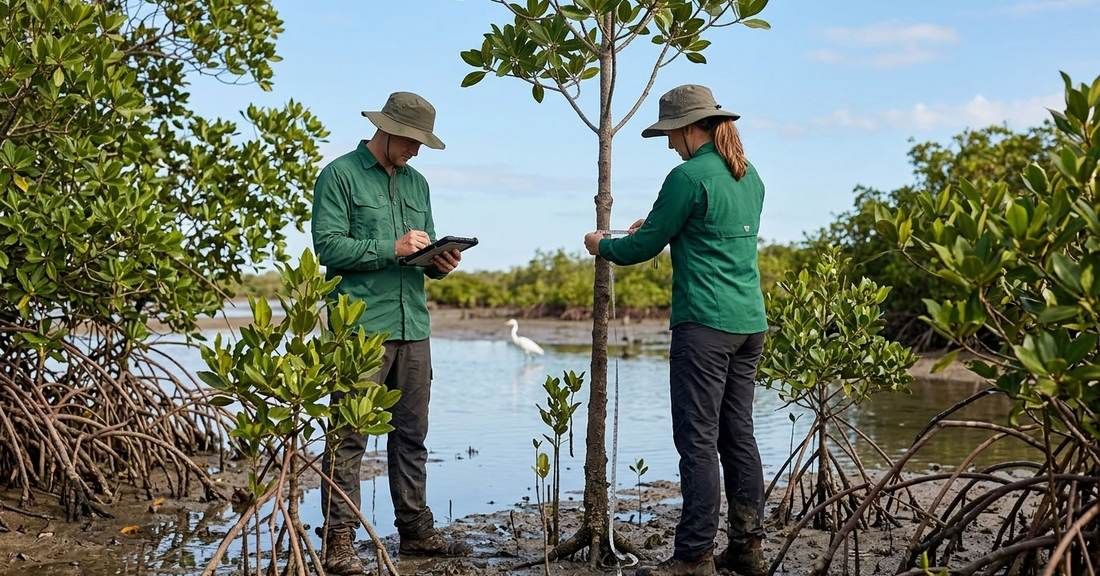
Blue carbon: mangroves, seagrass and tidal wetlands
Mangrove, tidal wetland and seagrass restoration under Verra's Verified Carbon Standard (VCS), including methodology VM0033 for tidal wetland and seagrass restoration: eligibility screening, baseline and carbon stock assessment, and monitoring plan design. We also screen salt marsh, seaweed and freshwater wetland projects.
Forests and land
REDD+ and jurisdictional REDD+ (JNR and ART-TREES), afforestation, reforestation and revegetation (ARR), improved forest management (IFM) and agroforestry: project design, additionality and leakage analysis, and non-permanence risk assessment. For trees on farmland in India, see Farm carbon credits.
Regenerative agriculture and soil carbon
Soil organic carbon and regenerative practice projects: baseline sampling design, the measurement and modelling approach, and grouped-project structures that bring many smallholder farms into one project.
Biodiversity and nature credits
Biodiversity-credit and nature-credit projects – site identification, methodology screening, baseline and monitoring, and links with carbon projects on the same land. For companies: biodiversity footprints, natural capital accounting, ecosystem services valuation and science-based targets for nature (SBTN).
TNFD disclosure support (LEAP)
Support for nature-related disclosures under the TNFD recommendations, using the LEAP approach: Locate your interface with nature, Evaluate your dependencies and impacts, Assess your risks and opportunities, and Prepare to respond and report.
More on our Natural capital and TNFD page.
How we work
- Screening. Eligibility, land rights, the likely standard and methodology, additionality, and the risks of non-permanence and leakage.
- Design. Baseline and carbon stocks, the monitoring plan, safeguards and community engagement.
- Documents. The project description or project design document, and preparation for validation.
- Monitoring and verification. Monitoring reports and support through verification and issuance.
- Buyers. A due-diligence pack for buyers, with registry and label status – such as the ICVCM CCP label – where relevant.
Who we work with
Project developers and landowners; farmer groups and their cluster managers; forest, coastal and farming programmes of governments and public bodies; corporate buyers looking for nature-based credits; and companies preparing nature-related disclosures.
Frequently asked questions
What makes a nature-based carbon credit high quality?
Real and additional reductions or removals, a conservative baseline, protection against reversal (permanence) and leakage, fair benefit-sharing with communities, and independent validation and verification. The Integrity Council for the Voluntary Carbon Market (ICVCM) assesses programmes and credit categories against ten Core Carbon Principles; credits from approved categories issued under approved programmes can carry the CCP label.
Are biodiversity credits the same as carbon credits?
No. A carbon credit stands for one tonne of carbon dioxide equivalent (tCO₂e) reduced or removed. A biodiversity credit stands for a measured gain in biodiversity at a site and is not used to offset carbon emissions. Biodiversity-credit methods are newer than carbon-credit methods, so we screen each method and the claims made with it.
How long does a nature-based project take to issue its first credits?
It depends on the project type, the standard and how fast trees, mangroves or soil carbon grow; removals must be measured and verified before credits are issued. We set out the expected timeline in the feasibility study.
Can many small farms or landowners join one project?
Yes. Grouped or aggregated projects bring many small land parcels into one project under one set of documents, with new areas added over time where the standard allows. Our farm page explains our aggregated tree-planting project.
Sources
- ICVCM, The Core Carbon Principles (icvcm.org), read 08-Nov-2026.
- Verra, VM0033 Methodology for Tidal Wetland and Seagrass Restoration, v2.1, active since 04-Sep-2023 (verra.org), read 08-Nov-2026.
- TNFD, Guidance on the identification and assessment of nature-related issues: the LEAP approach, v1.1, October 2023 (tnfd.global), read 08-Nov-2026.
Watch our short video
Send an enquiry
Indicates required question